How Do IB CAS Trips Work? A Guide for Schools and Parents
Quick answer: A CAS trip is a school trip planned around the IB Diploma’s Creativity, Activity and Service (CAS) requirement. A well-designed trip gives students real experiences in all three strands, links to the seven CAS learning outcomes and builds in time for reflection. It does not replace a student’s 18-month CAS programme, but it can be one of its most memorable parts.
For IB Diploma students, CAS sits alongside Theory of Knowledge and the Extended Essay as one of the three core elements of the programme. Many schools now plan a dedicated CAS trip to give students a concentrated burst of experiences that are hard to find at home. This guide explains what CAS requires, where a trip fits and how to tell a strong CAS trip from a sightseeing tour.
What is CAS?
CAS stands for Creativity, Activity and Service. It is one of the three core elements of the IB Diploma Programme, and students must complete it to be awarded the diploma. It is organised around three strands:
- Creativity: exploring and extending ideas, leading to an original or interpretive product or performance.
- Activity: physical exertion that contributes to a healthy lifestyle.
- Service: collaborative and reciprocal engagement with the community in response to an authentic need.
What CAS requires, in brief
- At least 18 months. Students take part in CAS regularly from the start of the Diploma Programme, with a reasonable balance between the three strands.
- Seven learning outcomes. Completion is based on students showing evidence of each outcome at least once.
- At least one CAS project. It must be collaborative, run over at least one month and combine at least two strands.
- A portfolio and reflections. Students record their experiences and reflect on them, and the CAS coordinator reviews progress in formal interviews.
The seven CAS learning outcomes are:
- Identify own strengths and develop areas for growth
- Demonstrate that challenges have been undertaken, developing new skills in the process
- Demonstrate how to initiate and plan a CAS experience
- Show commitment to and perseverance in CAS experiences
- Demonstrate the skills and recognise the benefits of working collaboratively
- Demonstrate engagement with issues of global significance
- Recognise and consider the ethics of choices and actions
Students plan CAS experiences and projects using five stages: investigation, preparation, action, reflection and demonstration.
Where a CAS trip fits
A trip is not a shortcut to finishing CAS. What it does well is pack several strong experiences into one week, in a setting students would not otherwise reach. A single trip can include:
- Service with a community that has asked for help, such as teaching workshops or building work at a village school
- Activity through trekking, cycling or outdoor challenges at altitude
- Creativity through documenting the trip, running a workshop or creating something with the community
Trips are also strong evidence for the harder learning outcomes. Living and working in an unfamiliar place pushes students to take on challenges (outcome 2), work closely as a team (outcome 5), engage with issues such as education, water or climate (outcome 6) and think about the ethics of their choices as visitors (outcome 7).
A trip can also be the action stage of a CAS project. If students research the community’s needs, plan the service work and prepare their materials at school in the weeks before travelling, then reflect and present afterwards, the whole process can meet the one-month, collaborative requirement.
What makes a good CAS trip
Use this checklist when you plan a trip or compare providers.
- A real, identified need. Service work should respond to what the community has asked for, agreed with local partners before the trip.
- Reciprocity. Students should learn from the community as much as they give. Avoid trips where service is a photo opportunity.
- Students involved in planning. The more students investigate and prepare, the more the trip counts towards outcome 3 and a CAS project.
- All three strands. A balance of creativity, activity and service gives students more to reflect on.
- Time for reflection. Daily reflection sessions on the trip make it much easier for students to write strong portfolio entries.
- Safety planned in. Written risk assessments, contingency plans, experienced leaders and, for mountain trips, time to acclimatise.
Example: an 8-day CAS trip to Ladakh
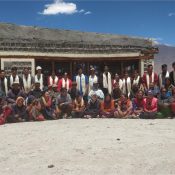
Escapade India’s flagship CAS trip to Ladakh shows how the strands come together. Students spend their first day acclimatising in Leh, visit the Shey, Thiksey and Sankar monasteries, and stay at a homestay near Pangong Lake. The heart of the trip is three days of service at a village school, with community building work and workshops in English, mathematics and environmental awareness.
- Service: building work and teaching at the village school
- Activity: trekking and physical building work at high altitude
- Creativity: designing and running the workshops for the school’s students
“The program beautifully combined adventure, cultural exposure, and meaningful community engagement, perfectly aligning with the spirit of the CAS (Creativity, Activity, Service) component of the International Baccalaureate curriculum.”
Principal, GD Goenka World School
Questions to ask a CAS trip provider
- How is the service project chosen, and who are the local partners?
- Which CAS strands and learning outcomes does the itinerary support?
- How are students involved before the trip, and is reflection built into each day?
- Who leads the group, and what are the risk assessment and emergency plans?
- Can the trip be adapted to your students’ grade, dates and budget?
Planning a CAS trip for your school?
Frequently asked questions
Does a school trip count towards CAS?
Yes, if it is planned that way. A trip can give students several CAS experiences across creativity, activity and service. Students still need to reflect on it and show evidence of the learning outcomes in their CAS portfolio.
Can a CAS trip be a student’s CAS project?
It can be part of one. A CAS project must be collaborative, run over at least one month and combine at least two of the three strands. A trip can be the action stage of a project that students investigate and prepare at school in the weeks before they travel.
How many CAS hours does a trip add?
The current CAS guide does not set an hours target. Completion is based on students showing evidence of all seven learning outcomes over at least 18 months.
When is the best time for a CAS trip?
Early in the Diploma Programme, usually in DP1. That leaves time to prepare beforehand, reflect afterwards and build on the trip with follow-up service at home.
Explore all our CAS and experiential learning trips or our school trips, or read whether a NASA Space Camp trip is worth it.